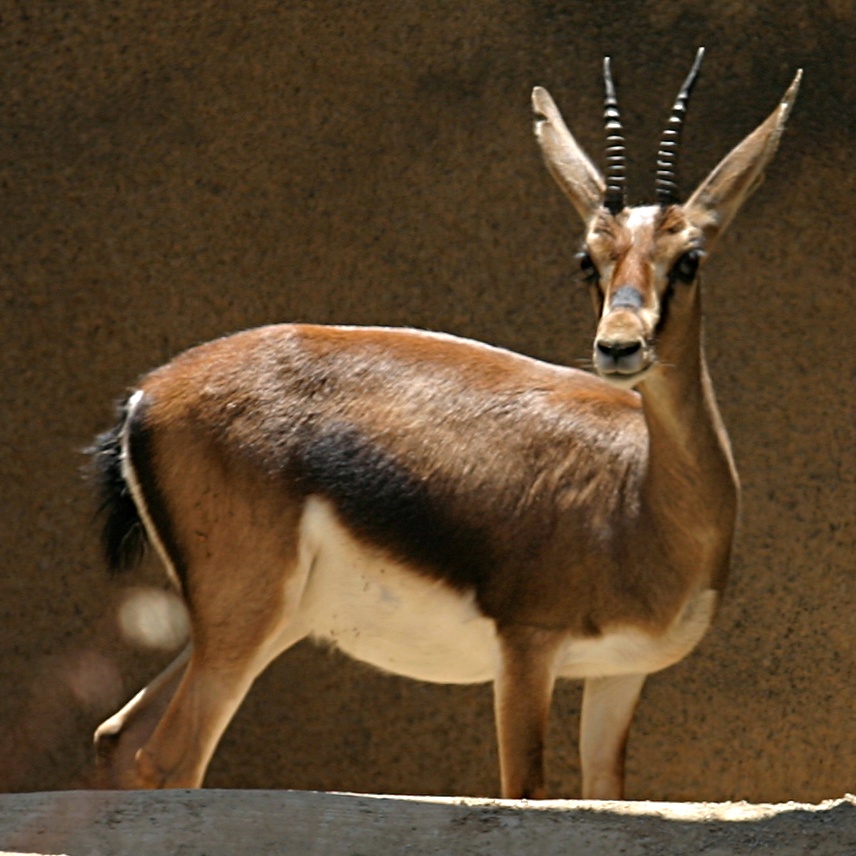
Overview
Cuvier's Gazelle appears on the Exotic Wildlife Association species list as Gazelle (Cuvier's) — ESA: Endangered; CITES: Appendix I. [1]
Native range
Atlas Mountains and nearby ranges of Morocco, Algeria and Tunisia; in Morocco from about 60 to 2,600 m elevation. [2][3]
Size
Adult males average 32.6 kg (range 24.5–40), females 26.4 kg (21–32) in the studbook population; general range 15–35 kg. [2][3]
Lifespan
Not verified from a primary source for this page.
Breeding & gestation
About 161–168 days; twins are frequent (~39–42% of births in captive studies). [4]
Temperament & social structure
Small groups, typically fewer than eight; harems of one male with a few females are common. [2]
Habitat needs
Hilly terrain: open oak and Aleppo pine forest, hill grasslands and stony desert plateaus, with rainfall from ~600 mm/yr down to desert fringe. [2]
Where they thrive (Texas / US)
Not verified from a primary source for this page.
Space per animal
No verified species-specific stocking rate was found. Carrying capacity depends on rainfall, range condition and competing grazers—get a range/stocking assessment (NRCS or Texas A&M AgriLife).
Housing & shelter
Not verified from a primary source for this page.
Fencing
Texas Parks & Wildlife states game fences at least 8 ft high (woven-wire or high-tensile) are the only fully reliable deer-exclusion fence. That is the common high-fence standard for deer and antelope; a species-specific minimum for this animal was not found in a primary source. [5]
Natural diet
Browser and grazer feeding on herbs and shrubs; needs to drink regularly. [2][3]
Feed & supplementation
No verified species-specific protein % or mineral formula was found. Texas deer guidance (16–20% CP pellet; 13–16% CP for growth/reproduction) is sometimes used as a reference point but is not antelope-specific—work with a ruminant nutritionist/exotic vet. [6][7]
Common health issues & parasites
Haemonchus contortus and Longistrongylus dominate abomasal worm burdens in free-ranging exotic antelope in Texas (sable, addax, blesbok studied); captive wild ruminants show anthelmintic resistance, so use fecal egg counts and fecal egg-count reduction tests instead of routine blanket deworming. [8][9]
Vet care & vaccination
No vaccines are labeled for this species in the US; any vaccination protocol is extra-label and should be set by a veterinarian experienced with exotic hoofstock. (No specific protocol was verified for this page.)
Handling & capture
Capture myopathy—muscle damage from pursuit, restraint and transport—is often fatal in wild ungulates. Minimize chase time and stress, avoid hot conditions, use appropriate chemical immobilization by a vet, and release/unload quickly. [10]
Conservation status
IUCN Red List: Vulnerable. [11]
Legal notes (general info, not legal advice)
Listed Endangered under the US Endangered Species Act (per the EWA list; confirm current status on USFWS ECOS). Interstate sale or transport of ESA-listed animals requires federal authorization. CITES: Appendix I. General information, not legal advice. USDA APHIS licensing under the Animal Welfare Act applies to dealers and exhibitors; check USDA and your state wildlife and animal-health agencies before buying, moving or selling. [1][12][13]
Sources
- Exotic Wildlife Association – Endangered Species List (ESA status & CITES appendix)
- EEZA-CSIC (2008) Cuvier's gazelle international studbook – biology & ecology
- CMS/RBINS Sahelo-Saharan antelopes – Gazella cuvieri description
- IUCN SSC (2018) Conservation strategy and action plan for Cuvier's gazelle in North Africa 2017–2026
- TPWD, Local Control Methods (deer damage): 8-ft woven-wire/high-tensile game fence
- TPWD, Specific Habitat Management Practices – White-tailed Deer (16–20% protein pellet; corn 7–10% CP)
- Tomeček, Texas A&M AgriLife Extension – Deer & goat co-management (6–7% CP maintenance; 13–16% CP growth/antlers/reproduction)
- Longistrongylus/Haemonchus in free-ranging exotic antelope in Texas (J. Wildl. Dis., PubMed 8355363)
- Anthelmintic activity in captive wild ruminants by fecal egg reduction tests (J. Zoo Wildl. Med. 2000)
- Breed et al. 2019, Understanding capture myopathy (Conservation Physiology, PMC6612673)
- IUCN Red List – Gazella cuvieri (assessment page)
- USFWS ECOS – Listed Animals (current ESA status)
- USDA APHIS – Animal Welfare Act licensing & registration
Figures are taken from the numbered sources; items marked "not verified" could not be confirmed from a primary source and are intentionally left blank. Husbandry guidance is general—confirm with an exotic-animal veterinarian.