Exotic Ranch & Wildlife Network

News, features and a statewide directory for exotic hoofstock and wildlife ranching, starting with Texas · DRAFT

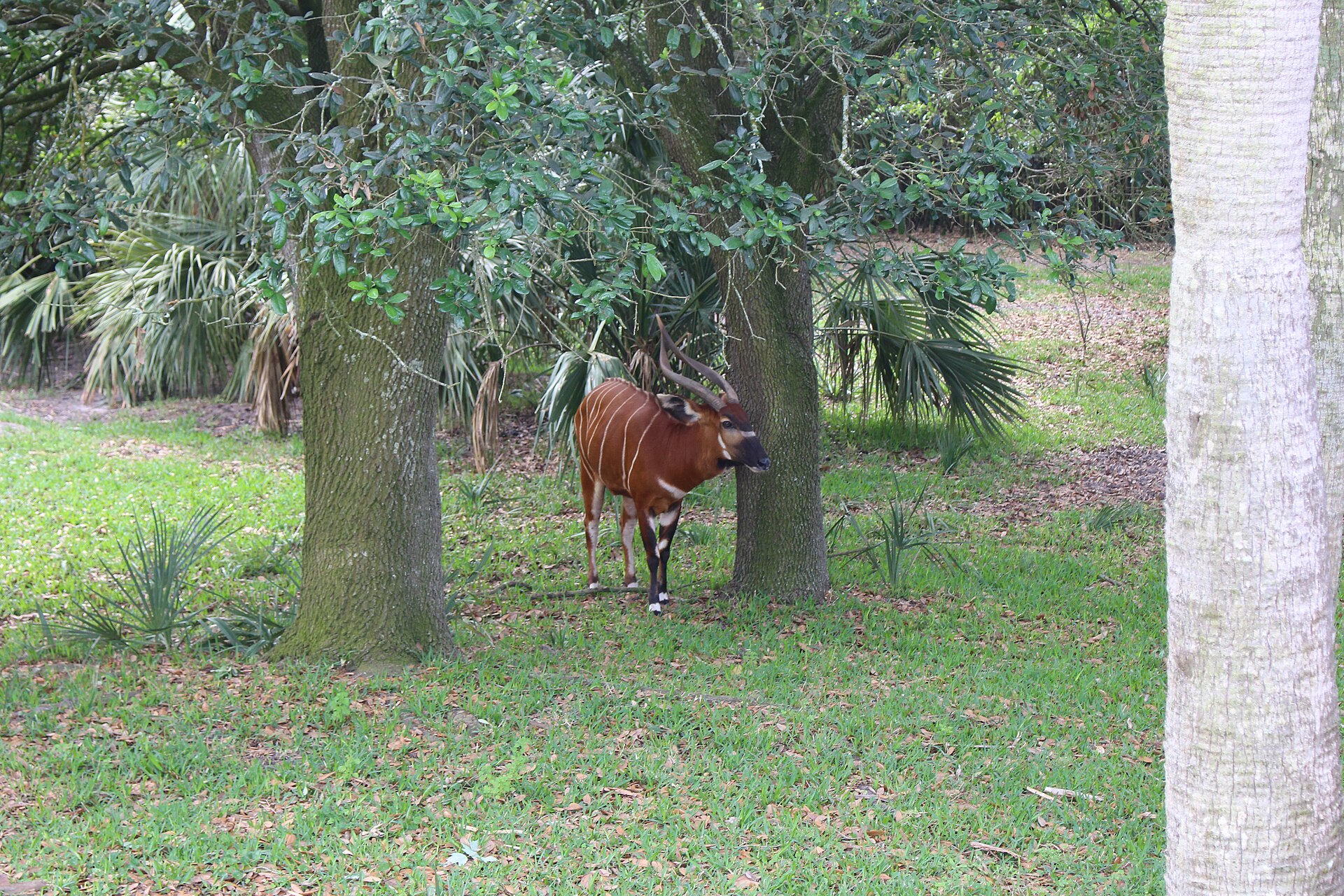
Bongo among trees, Jacksonville Zoo
Animal of the Month

Bongo

The striped forest antelope whose rarest form is being brought back with help from U.S. zoos. Read the spotlight ↓ · Species guide

Photo: Michael Rivera · CC BY-SA 4.0 · Wikimedia Commons
Industry story

Conservation Through Commerce: How Texas Ranches Kept Three Desert Antelope Alive

From the King Ranch's first nilgai to oryx released in Chad, the story of Texas exotics runs through ranch fences, Washington courtrooms and the Sahara.

Drive the Hill Country at dusk and you can see the results of a century-long experiment: blackbuck on a caliche ridge, axis deer at a creek crossing, an oryx's straight horns above the brush. None of these animals is native to Texas. All are here because ranchers brought them, bred them and found a way to make them pay. That commercial bargain has drawn plenty of argument over the years. It has also kept some of the rarest antelope on Earth from disappearing.

A century of “strangers on the range”

Scimitar-horned oryx
Scimitar-horned oryx. The IUCN declared the species Extinct in the Wild in 2000.[12] Photo: Cheima fezzani · CC BY-SA 4.0 · Wikimedia Commons

The Texas exotic industry is usually dated to South Texas. According to the Handbook of Texas, the King Ranch made several acquisitions of nilgai from zoo stock between about 1930 and 1941 and released them in Kenedy County.[2] The ranch says its first nilgai brood stock came mainly from the San Diego Zoological Garden in the late 1920s.[3] The Indian blackbuck followed: the Handbook dates its introduction in Kerr County to 1932.[4] Today the Handbook puts the nilgai at roughly 15,000 head on Texas rangelands and the blackbuck at nearly 19,000.[2][4]

The Hill Country turned curiosity into a business. On the Y.O. Ranch near Kerrville, Charles Schreiner III took in surplus animals from the San Antonio Zoo. The ranch's own history tells how a visitor offered in 1957 to pay $125 to hunt a blackbuck, the moment it calls the birth of a new industry.[5] By the same account, more than 600 ranches had followed the Y.O.'s lead by 1967. That was the year Schreiner and fellow ranchers formalized the movement as the Exotic Wildlife Association.[5]

The EWA and “conservation through commerce”

The Kerrville-based EWA describes itself as the oldest organization in North America dedicated to preserving and managing exotic hoofstock through private ownership. It was founded to protect the rights of exotic wildlife and alternative livestock owners and to support the industry's sustainable growth.[1] Its motto, “Conservation through Commerce,” sums up the argument the industry has made ever since. If a species has value to the people who own the land, those people will invest in fences, feed, water and veterinary care to keep it.

If a species has value to the people who own the land, those people will invest in keeping it.

The scale of that investment was measured in 2007, when Texas A&M's Agricultural and Food Policy Center surveyed industry participants. The study put the industry's direct economic impact at $679.7 million a year. Combined breeding and hunting activity came to $1.3 billion annually, supporting 14,383 jobs, most of them rural.[6] Those figures are now nearly two decades old, and no newer peer-reviewed estimate was found for this article. In a later interview, EWA's executive director told the Texas Observer that about 5,000 Texas ranches held at least one exotic species, with more than 2 million animals of 135 species.[7]

The three amigos

Addax bull
Addax: one of the three antelope at the center of the 2005–2014 rule fight.[8] Photo: HaytemBouchri93 · CC BY-SA 4.0 · Wikimedia Commons

No chapter shows the industry's conservation claims and its legal exposure more clearly than the saga of the scimitar-horned oryx, the addax and the dama gazelle. Ranchers often call them the “three amigos.” All three are Sahelo-Saharan antelope that collapsed in the wild while multiplying on private land in the United States.

On September 2, 2005, the U.S. Fish and Wildlife Service listed all three as endangered under the Endangered Species Act. The same day it issued a companion rule, 50 CFR 17.21(h), that excluded U.S. captive-bred animals from certain prohibitions, including take, interstate commerce and export. The Service's reasoning was that the species depend on captive breeding, and that captive-breeding activities in the U.S. enhance their propagation or survival.[8][10]

Animal-protection groups sued. In 2009 the U.S. District Court for the District of Columbia found that the rule violated section 10(c) of the Act by denying the public a chance to comment on activities involving the three species, and sent it back to the Service.[10] The Service removed the exclusion in a rule published January 5, 2012, effective April 4, 2012. From then on, ranchers needed an individual exemption or permit for activities the Act otherwise prohibits.[9] In June 2013 the Service rejected petitions to delist the U.S. captive herds, ruling that captive animals do not qualify as a separate “species” under the Act.[10]

Dama gazelle (mhorr)
Dama gazelle.[11] Photo: Ltshears · CC BY-SA 3.0 · Wikimedia Commons

Congress stepped in next. A provision of the Consolidated Appropriations Act of 2014, enacted January 17, 2014, directed the Interior Secretary to reissue the 2005 rule within 60 days. The Service did so effective March 19, 2014. Activities that meet the rule's propagation-or-survival criteria could again proceed without an individual permit, though only for U.S. captive-bred animals, and CITES requirements still apply.[11]

For ranchers, the permit years were a lesson in how quickly a regulatory change can reshape herd economics. No verified census of how herds changed during 2012–2014 was found, so this article doesn't estimate one.

From Texas pastures back to the Sahara

The wild side of the story has moved faster than many expected. The IUCN declared the scimitar-horned oryx Extinct in the Wild in 2000.[12] In 2016 the first 25 oryx were flown from Abu Dhabi to central Chad and released into the Ouadi Rimé-Ouadi Achim Faunal Reserve, under a program led by the Environment Agency – Abu Dhabi with Sahara Conservation and the Government of Chad. The first calf was born there that December.[12] On December 11, 2023 the IUCN downlisted the species to Endangered. Partners named in the announcement included Texas's own Fossil Rim Wildlife Center.[13] Sahara Conservation's 2025 annual report counts about 650 oryx and 130 addax roaming free in the reserve.[14]

The release herds came from a genetically managed “World Herd” held in Abu Dhabi rather than directly from Texas ranches.[13] But the case industry advocates make is straightforward: large, privately held captive populations are an insurance policy, and that policy paid out in Chad.

The southern African mirror

Texas is not alone. In South Africa, a 2016 Endangered Wildlife Trust study estimated about 9,000 wildlife ranches covering roughly 17 million hectares. That is about 2.2 times the area of the country's state protected-area network, mostly converted from livestock farms.[15] The study estimated some 6 million large herbivores on those ranches in 2014, which it called a ten-fold increase since the boom began. It also found R4.3 billion in live-game sales, R2.6 billion in hunting revenue and 65,170 permanent jobs that year.[15] It flagged a caution that Texas ranchers will recognize too: intensive breeding camps for high-value animals and color variants were growing, along with fencing that fragments habitat.[15]

What comes next

Genetics. Small founder herds make careful record-keeping and bloodline management a core business skill, not an afterthought. The oryx reintroduction relied on genetic testing of its source herd.[13]

Regulation. The 2005–2014 saga showed that federal status can change through the courts as well as through Congress. Owners of ESA-listed species should keep their paperwork current and follow rulemaking closely.

Disease. Chronic wasting disease has made animal movement and testing rules a constant part of deer-family management in Texas. Check current requirements with Texas Parks & Wildlife before moving susceptible species.[16]

Tourism and partnerships. Drive-through parks, giraffe encounters and conservation-minded ranches (see our Conservation, Zoos, Safaris & Animal Parks directory) give the public a direct line to these animals. Partnerships between private herds, accredited zoos and range-country programs are how the oryx came home.

The next century of Texas exotics will probably be judged by the standard the EWA set for itself in 1967: whether commerce keeps paying for conservation.

Animal of the Month · Spotlight

The Bongo: Ghost of the African Forest

Striped, shy and spectacularly horned, the bongo is a forest antelope whose rarest form now depends on cooperation between Kenya, U.S. zoos and private breeders.

Bongo portrait
Bongos browse with a long prehensile tongue and pull down high branches with their horns.[17] Photo: Mathias Appel · CC0 · Wikimedia Commons

In the wild

The bongo (Tragelaphus eurycerus) is the heavyweight of Africa's forest antelope, ranging from about 210 to 405 kg.[17] Two forms are recognized. The lowland or western bongo (T. e. eurycerus) lives mainly in the lowland forests of West and Central Africa.[17][18] The eastern or mountain bongo (T. e. isaaci) is found only in Kenya, in the mountain forests of Mount Kenya, the Aberdares and the Mau complex.[20]

According to Animal Diversity Web, the bongo is the only forest antelope to form herds, from 5 or 6 animals up to 50. It is active by day and night, but keeps to dense cover by day and visits salt licks after dark. Its reclusive habits are why its behavior has been hard to study.[17] Bongos are browsers and grazers, preferring young leaves, and are known to eat burned wood for its minerals.[17]

The IUCN lists the species as a whole as Near Threatened.[18] The mountain subspecies is assessed as Critically Endangered.[19] Rhino Ark's field monitoring suggests fewer than 80 mountain bongo remain in the wild, across four separate ecosystems.[20] ADW notes that although bongos are difficult to shoot, they are easily hunted with dogs.[17]

Female mountain bongo photographed at Mount Kenya
A female mountain bongo photographed at Mount Kenya, where the 2004 repatriation herd was based. Photo: Chuckupd at English Wikipedia · Public domain · Wikimedia Commons

Bringing the mountain bongo home

On January 29, 2004, a freighter landed in Nairobi carrying 18 mountain bongo: 4 males and 14 females. They came from U.S. zoos after 90 days of quarantine at White Oak Conservation Center in Florida. This was the culmination of a 10-year campaign by the Rare Species Conservatory Foundation.[21] The animals went to the Mt. Kenya Game Ranch, which became the Mt. Kenya Wildlife Conservancy, as founders for a long-term breeding effort. Partners included the Kenya Wildlife Service, 13 U.S. zoological parks and the AZA Bongo Species Survival Plan, which manages captive bongo in U.S. zoos.[21] RSCF says the project helped inspire Kenya's National Recovery and Action Plan for the Mountain Bongo, ratified in 2019. A new bongo and black rhino sanctuary in Mount Kenya's Marania forest launched in January 2024.[21]

In the field, Rhino Ark runs camera-trap and forest-security work in the Mt. Kenya and Mau Eburu ecosystems with teams drawn from neighboring communities. Its partners include the Kenya Wildlife Service, Kenya Forest Service, Wilder Institute/Calgary Zoo and the Bongo Surveillance Project. Rhino Ark says the long-term goal is to recover wild herds by drawing on bongo held in zoos and breeding facilities in Kenya and abroad.[20]

Bongo on ranches and in captivity

Bongo are present on Texas ranches today: ranches in our directory, including the 777 Ranch, list bongo among their species.[22][23] In the wild they are a forest animal, so anyone considering them should plan habitat and care with an exotic-hoofstock veterinarian. Our bongo species guide covers what we could verify on diet, parasites, fencing and capture risks, and marks what we couldn't. Two points from it apply to any antelope. Capture myopathy can be fatal, so handling should keep chase time and heat stress to a minimum. And parasite control should be guided by fecal egg counts rather than blanket deworming.

Read the full bongo species guide →

Sources

  1. Exotic Wildlife Association – About Us: https://myewa.org/about-us/
  2. Texas State Historical Association, Handbook of Texas – Nilgai Antelope: https://www.tshaonline.org/handbook/entries/nilgai-antelope
  3. King Ranch – Hunting: https://king-ranch.com/operations/hunting/
  4. Texas State Historical Association, Handbook of Texas – Indian Blackbuck Antelope: https://www.tshaonline.org/handbook/entries/indian-blackbuck-antelope
  5. Y.O. Ranch Headquarters – Charles Schreiner III: https://yohq.org/schreiner-iii
  6. Anderson, Frosch & Outlaw, Economic Impact of the Exotic Wildlife Industry, Texas A&M Agricultural and Food Policy Center (Aug. 2007): https://afpc.tamu.edu/research/publications/496/rr-2007-02.pdf
  7. Texas Observer – “The Texotics” (figures attributed to EWA's executive director): https://www.texasobserver.org/the-texotics/
  8. Federal Register, Sept. 2, 2005 – Exclusion of U.S. captive-bred scimitar-horned oryx, addax and dama gazelle from certain prohibitions: https://www.federalregister.gov/documents/2005/09/02/05-17432/endangered-and-threatened-wildlife-and-plants-exclusion-of-us-captive-bred-scimitar-horned-oryx
  9. Federal Register, Jan. 5, 2012 – Removal of the captive-bred exclusion (effective April 4, 2012): https://www.federalregister.gov/documents/2012/01/05/2012-23/endangered-and-threatened-wildlife-and-plants-removal-of-the-regulation-that-excludes-us
  10. Federal Register, June 5, 2013 – 12-month findings on petitions to delist U.S. captive populations: https://www.federalregister.gov/documents/2013/06/05/2013-13268/endangered-and-threatened-wildlife-and-plants-12-month-findings-on-petitions-to-delist-us-captive
  11. Federal Register, March 19, 2014 – Reinstatement of the captive-bred exclusion (Consolidated Appropriations Act, 2014): https://www.federalregister.gov/documents/2014/03/19/2014-05954/endangered-and-threatened-wildlife-and-plants-reinstatement-of-the-regulation-that-excludes-us
  12. Sahara Conservation – Scimitar-horned oryx reintroduction: https://saharaconservation.org/species-recovery/the-scimitar-horned-oryx-reintroduction/
  13. Sahara Conservation – Oryx downlisted from Extinct in the Wild to Endangered (Dec. 11, 2023): https://saharaconservation.org/news/milestone-the-scimitar-horned-oryx-downlisted-from-extinct-in-the-wild-to-endangered-by-iucn/
  14. Sahara Conservation – Annual Report 2025: https://saharaconservation.org/wp-content/uploads/2026/06/Annual-Report-2025_digitale_VF.pdf
  15. Endangered Wildlife Trust – The role of the wildlife ranching industry in South Africa's green economy (2016): https://endangeredwildlifetrust.wordpress.com/2016/02/11/the-role-of-the-wildlife-ranching-industry-in-south-africas-green-economy/
  16. Texas Parks & Wildlife Department – Chronic Wasting Disease: https://tpwd.texas.gov/huntwild/wild/diseases/cwd/
  17. Animal Diversity Web (Univ. of Michigan) – Tragelaphus eurycerus: https://animaldiversity.org/accounts/Tragelaphus_eurycerus/
  18. IUCN Red List – Tragelaphus eurycerus (species): https://www.iucnredlist.org/search?query=Tragelaphus%20eurycerus
  19. IUCN SSC Antelope Specialist Group (2017) – Tragelaphus eurycerus ssp. isaaci, IUCN Red List assessment: https://doi.org/10.2305/iucn.uk.2017-2.rlts.t22057a50197212.en
  20. Rhino Ark – Recovering mountain bongo on the brink of extinction: https://www.rhinoark.org/giving-a-future-to-the-last-80-mountain-bongo-remaining-in-the-wild/
  21. Rare Species Conservatory Foundation – The 2004 Bongo Repatriation: https://www.rarespecies.org/2004-repatiration
  22. 777 Ranch – Bongo: https://www.777ranch.com/items/bongo
  23. OX Ranch (bongo listed among hunted species in our directory entry): https://www.oxhuntingranch.com/

Figures come only from the numbered sources. Where a figure couldn't be verified, it was left out.

Photo credits

More species photo and banner silhouette credits: Species photo credits & licenses.